
Lab Culture & Resources
Ethics
At COMPARE, we work with a multitude of species and sensitive groups. That primarily includes children, companion dogs, and non-human primates. However, we do collaborate and work with teams that study other species. With that in mind, we must hold ourselves to certain standards and practices as researchers.
Community
At COMPARE, we believe in and strive for a community of inclusion where all individuals interested in and passionate about contributing to our lab and research are supported. The scientific pursuit is collaborative, and we believe in diversity, equity, inclusion, justice, and belonging. This extends interpersonally, Institutionally, and across academia from top to bottom and bottom to top.
Code of Conduct:
As a lab member, there are certain expectations for your lab conduct. We expect lab members to:
-
Treat the lab space with care
Keep the lab clean and organized. The lab is a shared space, so be thoughtful about keeping it tidy for your fellow lab members. Be careful with lab equipment
Treat all lab members with respect, kindness, and professionalism, regardless of experience level
Come into the lab on time and prepared
Communicate effectively and report scheduling conflicts promptly
Report any unwarranted behavior or misconduct witnessed to a lab administrator. Harassment of any kind by or toward our lab members will not be tolerated
-
Be curious, open, and humble in exploring new things and learning new things
Support yourself and your fellow lab members in reaching their goals
-
We aim to maintain high levels of integrity, professionalism, and kindness during our work. Our conduct represents not only the lab, but Indiana University as a whole!
-
Protect the confidentiality of all participant information
Secure sensitive personal information and data in the lab storage, and never copy or retain information in personal devices
Treat participants thoughtfully throughout their interactions with the lab and lab members
Be sensitive to the vulnerable nature of our participants. The majority of the participants you will be working with are children and companion dogs. These populations require special care and consideration to ensure their safety and privacy
Exercise an abundant amount of caution and care
Be receptive to personal scrutiny and actively scrutinize our practices. We are all responsible for the protection of our participants
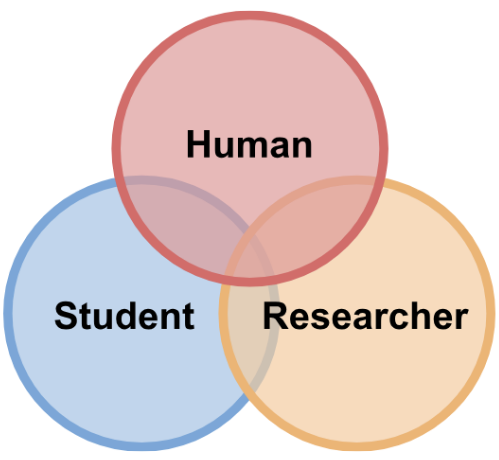
You’re all three, however, it’s important to remember that you’re human first, a student second, and a researcher third. That means that your mental well-being, health, family, and personal life come before anything else. You’re also a student, and your education is important. While there are overlaps between your work as a lab member and your coursework, your education should be your priority. Finally, you are a researcher. Our lab members are the cornerstone of our work, and we aim to allow you to grow, learn, and contribute meaningfully to research you care about! If something in your personal or student life is coming between your ability or availability to do research work, let us know. We will understand and work together to make adjustments where needed.
As an undergrad or graduate student, you’re a human, a student, and a researcher
Resources
For Undergrads
-
Resources for navigating grad school, post-bacc positions, writing a CV, scientific reporting, and more can be found here:
The Psych Research List by Dr. Meltem Yucel
Resources for undergrads and applying to grad school curated by the PINE Lab
Publishing as an undergrad:
Undergraduates who conduct research projects under the mentorship of a faculty member at IU (whether that’s in a lab or for a class) can submit their work for publication in the IU Journal of Undergraduate Research
-
Many labs advertise paid research opportunities, summer internships, and PHD program recruitment through listservs (email lists). Some notable lists related to our research include:
-
Center For Possible Minds
Dr. Erica Cartmill, along with collaborators, runs an annual summer program called The Diverse Intelligences Summer Initiative! (DISI)
at IU:
For IUB STEM student’s looking for a foray into research
A $2700 stipend and on campus housing is provided
Indiana University REU Program in Animal Behavior
This NSF-sponsored program for undergrads is hosted by CISAB (Center for Integrative Study of Animal Behavior) at IU
A single occupancy room
A food stipend
Travel expenses
A stipend of about $7000 (Stipends depend upon available funds)
STEM Summer Scholars Institute
For IU students and external students from Minority Serving Institutions to gain graduate level research experience
Stipend of up to $4000. Housing and meal’s also provided
Outside of IU, there are programs accepting students on a national level. Examples include:
Harvard’s Laboratory for Developmental Studies
Guaranteed minimum stipend of $5000
UC Berkeley Developmental Labs
Stipend ranging from $0-$3000
Yale Summer Undergraduate Research Fellowship (SURF)
$4000 stipend, along with housing and a $1000 food allowance
University of Chicago Early Social Thinkers lab
$3000 stipend
Michigan Summer Program in Cognition and Early Development
NSF-sponsored stipend
For Grad students & Post Docs
-
The PINE lab has curated helpful resources for grad students and postdocs to get the most out of their experience, find funding, and navigate career choices
-
John Hopkins maintains a repository of funding opportunities for Grad student’s, Post Docs, and Early Career Researchers